Land Holding, Land Taking and the Geography of Violence
Land Holding, Land Taking and the Geography of Violence
Dr. Danielle Purifoy | The University of North Carolina Dr. Annette Rodriguez | The University of Texas at Austin Dr. Louise Seamster | University of Iowa
Monday, February 12, 2024 | 12:30 pm Brazos Hall & Online via Zoom
Registration Closed
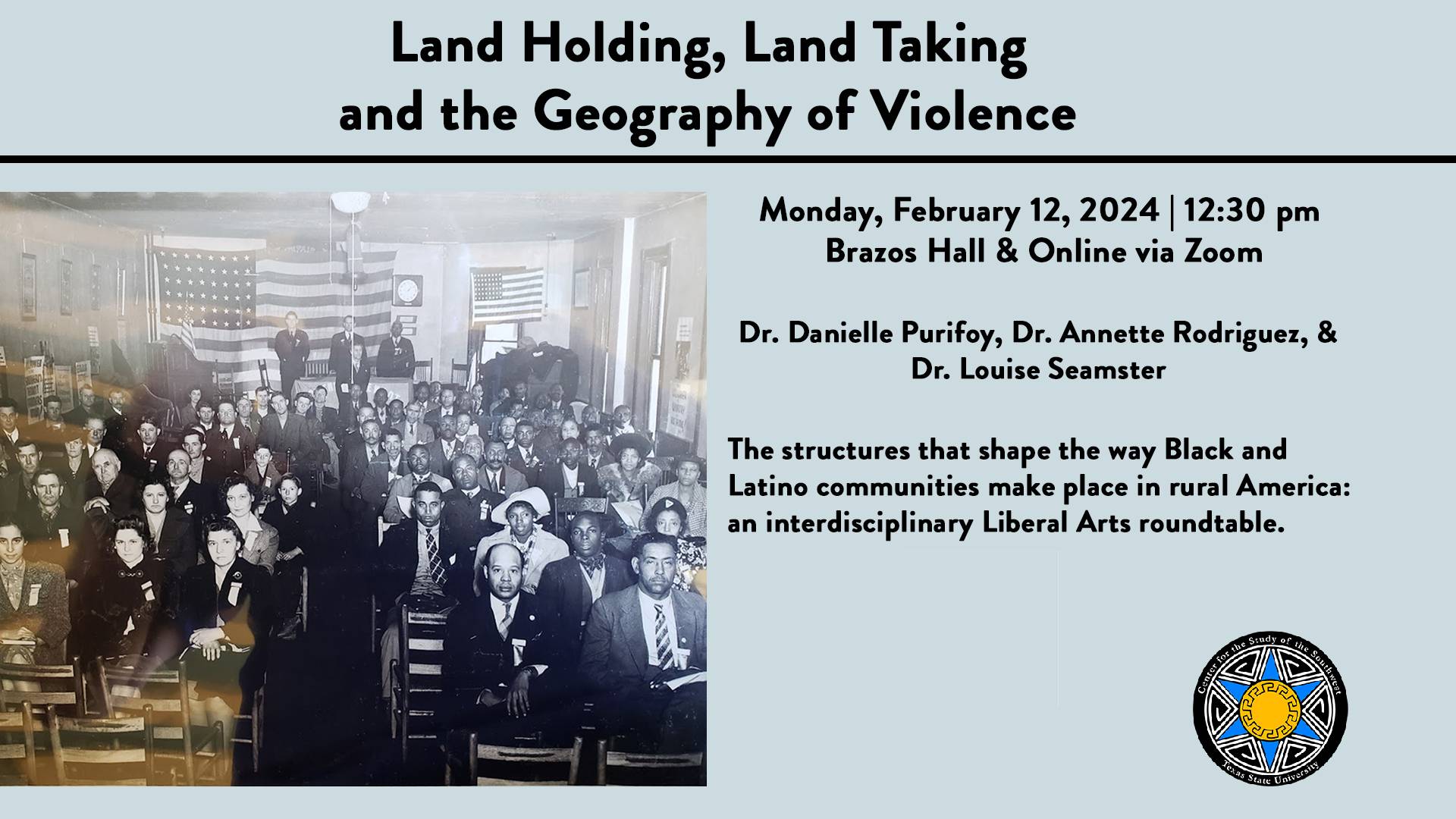
Land. Land and Power. From Black sharecroppers whose actions transformed our understanding of democracy to the agricultural labor strikes across the Southwest, control and authority over rural work and property have been part of civil rights and social movements in the United States, as crucial catalysts for and a vehicle to expand our understanding of civil rights. Historian Annette Rodriguez, Sociologist Louise Seamster and Geographer Danielle Purifoy share what they have learned through their research on Black and Mexican land grants; Tamina and the growth of the Woodlands; and golf resorts and Black rural displacement. Understanding the historically structured relationships that perpetuate rural inequality can help us reframe the places of Black and Brown communities in the Narrative of America.
is an assistant professor in the Department of Geography at The University of North Carolina at Chapel Hill. They completed a Ph.D in Environmental Politics and African American Studies at Duke University. They earned a B.A. in English and Political Science from Vassar College, and a J.D. from Harvard Law School. Their current research traces the roots of contemporary environmental conditions in the U.S. South, specifically in Black towns dating back to the post-Bellum era. They have also written about the legal dimensions of environmental justice and equity in food systems.
They are the former Race and Place Editor editor at , a magazine devoted to Southern politics and culture, and the former Board Chair of the . They also serve on the Board of Directors of .
Dr. Annette Rodr穩guez completed her BA and MA in American Studies at the University of New Mexico and her PhD at Brown University. Her research interests focus on the functions of public violence in U.S. empire and nation building, U.S. racial formation, immigration, and the production of U.S. citizenship. Dr. Rodr穩guez���s book project in progress Inventing the Mexican: The Visual Culture of Lynching at the Turn of the Twentieth Century centers performance, popular culture, and visuality as assisting in the relational construction of race. This text argues public violences reproduce the vulnerable, unprotected, raced figurations of personhood. In addition, Inventing the Mexican traces the specificity and historical constructions of categorical personhood.
In addition, Dr. Rodr穩guez has initiated a data, mapping, and social history project on U.S. bounty land grants. This project tracks the over sixty million acres of land granted by both the U.S. federal government and individual states as incentive to serve in the military and as a reward for service. It is provisionally titled Intimate Acquisitions: A Relational History of U.S. Bounty Lands.
Dr. Rodr穩guez���s publications include ���Antigone���s Refusal: Mexican Women���s Reponses to Lynching in the Southwest,��� The Journal of South Texas, Spring 2018; ���La Liga Femenil Mexicanista: The Proto-feminism and Radical Organizing of Journalist Jovita Id獺r,��� in From Sit-ins to #revolutions: The Changing Nature of Protests, Bloomsbury Academic, 2018; and ���Lonely Visions of Anxious Objects,��� in Convoluting the Dialectical Image ��� Special Issue, The International Journal for the Practice and Theory of Creative Writing, Taylor & Francis, 2019.
In 2017, Dr. Rodr穩guez received the 7th Annual Gloria E. Anzald繳a Award from the American Studies Association Committee on Gender and Sexuality, and in 2015, was presented the 18th annual Catherine Prelinger Award by the Coordinating Council for Women in History for her scholarly and professional contributions to women in history, and for educating young women to pursue careers in the historical profession. Dr. Rodr穩guez has taught at Brown University, the Institute of American Indian Arts, the University of New Mexico, and the University of North Carolina at Chapel Hill.
is a sociologist whose research examines contemporary mechanisms for the reproduction of racial and economic inequality. She is an assistant professor in the Department of Sociology and Criminology and the program of African American Studies at the University of Iowa. She is also a Research Fellow in the Social and Education Policy Research Program at the University of Iowa���s Public Policy Center, and a Nonresident Fellow in Governance Studies at the Brookings Institution.
Dr. Seamster's research centers on politics and urban development, emergency financial management, debt, and the myth of racial progress. Her first book, The Flint Water Coup: Debt at the End of Democracy (under contract with Columbia University Press), investigates the financial and political causes of the Flint Water Crisis. In parallel, her Flint Email Lab of graduate and undergraduate students is creating a website archive of public government email communications relating to the crisis. Another line of research examines racial disparities in debt. Her work on "predatory inclusion" in student debt has led to extensive policy work, including research informing Senator Elizabeth Warren's student debt forgiveness plan. Her many media appearances include the New York Times��� Ezra Klein Show, WNYC���s The Takeaway, Bloomberg News, and other national outlets.